The Theology of a Crooked Casserole: What the Potluck Table Keeps Teaching Us
I used to think the church potluck was the least theologically serious hour of the week. The sermon was over. The hymns were done. Now we were just eating. But somewhere between the deviled eggs and the third variation of macaroni and cheese, I started to suspect that the potluck was actually one of the most honest things we do together.
The Table With No Maître D'
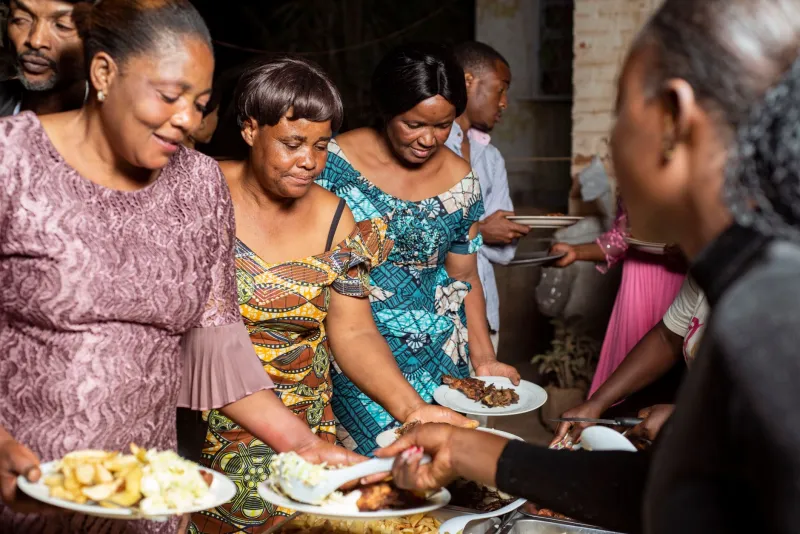
Our fellowship hall has folding tables that never quite line up and chairs that look like they were donated by three different decades. The casseroles are crooked. The labels are handwritten. Someone always forgets a serving spoon. Someone else always finds one in a drawer marked "miscellaneous."
There is no maître d' at a potluck. No one checks your credentials. No one asks whether your dish is impressive enough. You can bring a gourmet braise or a bag of chips. The table receives both.
That sounds simple, but it is not. Most of us spend a lot of energy trying to appear competent. We curate our lives. We edit our sentences. We make sure the casserole looks like the picture. The potluck interrupts all of that. It invites us to show up with what we actually have, not what we wish we had.
Everyone Brings Something
Margie has been a member of Faith Alive UMC for more than forty years. She has watched a lot of potlucks come and go. When I asked her what the table means to her, she did not talk about the food at first. She talked about the math.
"Everybody brings something," she said. "That is the whole thing. You do not have to bring enough for everybody. You just bring what you can. And somehow there is enough."
That is not just a catering strategy. It is a picture of grace. In a lot of areas of life, we are told to be self-sufficient. Bring your own everything. Do not be a burden. But the potluck assumes interdependence. It assumes that you will need something from someone else, and that someone else will need something from you. The table is not complete until we all put something down.
Paul wrote about the church as one body with many members. At a potluck, that stops being an abstraction. The person who brings rolls and the person who brings a roast are not in competition. They are making a meal together. The person who forgot to bring anything is not kicked out. They are handed a plate.
The Casserole Is Not the Point
I also talked with Daniel, who visited Faith Alive UMC for the first time earlier this year. He came because a coworker invited him. He stayed, he said, because of the food.
"I came for the free lunch and stayed because someone asked me about my deviled eggs," he told me. "I did not make deviled eggs. I brought chips. But she acted like chips were a spiritual gift."
That story has stayed with me. It is funny, but it is also a quiet description of welcome. Daniel did not have to pretend to be a casserole person. He brought what he had. Someone made room for it.
The casserole itself is not the point. The point is the passing. The point is the moment when someone notices you are standing alone and says, "Sit here." The point is the second helping, the plastic fork, the conversation that goes longer than you planned.
In a culture that often treats meals as fuel or performance, the potluck treats a meal as a rehearsal for the kingdom of God. Everyone has a place. Everyone has something to offer. No one is in charge of perfection.
A Quiet Antidote to Isolation
In 2026, isolation is easy to come by. We can order groceries without talking to anyone. We can work, worship, and watch just about anything without leaving the house. Convenience is a gift, but it can also thin out the ordinary contacts that used to hold neighborhoods together.
The potluck is not a cure for loneliness. It is too small for that. But it is a quiet antidote. You do not have to be funny at a potluck. You do not have to have a testimony prepared. You do not have to know which fork to use. You can sit down with a plate and be a person among people.
That is a tangible form of faith in action. It is not dramatic. It will not make headlines. But it is the kind of thing that keeps a church from becoming a building people visit and turning it into a table people belong to.
What We Keep Learning
I have started to think of the potluck as a parable we eat. The kingdom of God is like a table where the chairs do not match and the casseroles are uneven. The kingdom of God is like a meal where no one audits your contribution and everyone gets a plate. The kingdom of God is like a fellowship hall where the Jell-O salad is unidentified but the welcome is clear.
Grace, after all, is not a perfect casserole. Grace is a crooked table where there is always room for one more. Grace is the passing of a dish. Grace is the person who says, "Try this—I made too much." Grace is the invitation to bring what you have and receive what you need.
So if you are nearby on a Sunday, come to the potluck. Bring something or bring nothing. Sit at the end of the table. Take a chance on a mystery dish. You may not leave with a neat answer to life's hardest questions, but you just might leave with a plate, a story, and the quiet sense that you were expected.