The Wednesday With Nothing on the Schedule (And Why That’s the Whole Point)
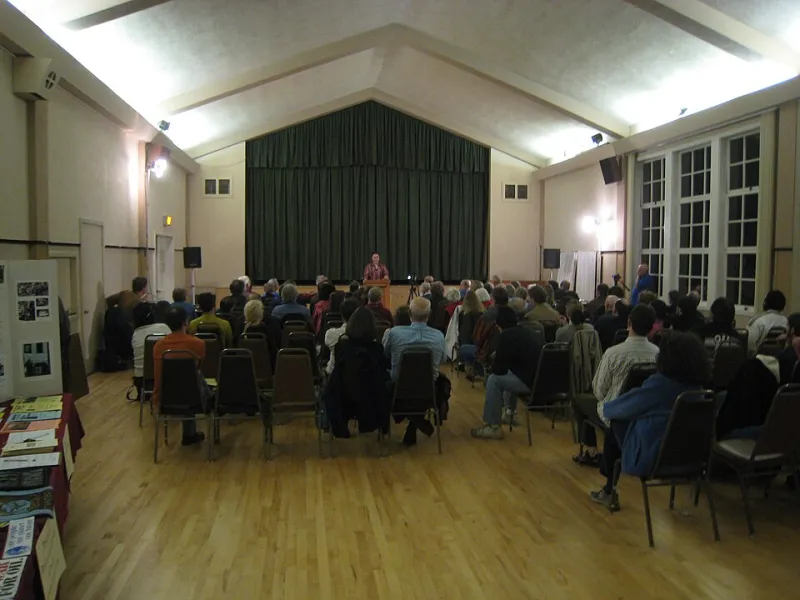
Photo: shmooth, CC BY 2.0, via Wikimedia Commons
The coffee starts at 6:00. The doors are unlocked by 5:50. By 6:15, there are three conversations going, a half-finished puzzle on one table, and a kid setting up Connect Four like it’s his job. Nobody has welcomed the group. Nobody has asked anyone to introduce themselves. There is no handout, no PowerPoint, and no opening prayer scheduled. It’s the no-agenda Wednesday at Faith Alive UMC, and the whole point is that there isn’t one.
Once a month, we open the fellowship hall for two hours and then mostly get out of the way. No speaker. No Bible study. No sign-up sheet taped to the door. We put out coffee, decaf, hot water for tea, and whatever cookies showed up. We set out board games, cards, a couple of puzzles, and a few tables with nothing on them at all. Then we let people decide what to do with the room.
What We Actually Put Out
The setup is almost embarrassingly simple. Two long tables for drinks and snacks. Four round tables with chairs. A shelf of games that have survived youth group, potlucks, and at least one flooded basement. A basket of decks of cards. A sign on the door that says: come in, stay as long as you like.
The volunteers for the night are not greeters in the formal sense. We call them room hosts. They make coffee. They wipe a spill. They start a game if a table looks stuck. But their main job is to resist the urge to turn the evening into something else. No announcements. No mini-sermon. No gentle push toward a small group. If someone wants to talk about faith, great. If someone wants to talk about the Orioles’ bullpen, also great. If someone wants to sit alone with a cup of tea and a puzzle, that’s fine too.
Who Comes When There’s Nothing to Come For
The crowd changes every month. Some nights it’s eight people. Some nights it’s closer to thirty. We’ve had retirees, shift workers, parents with kids in pajamas, teenagers who came for the snacks and stayed for the card game, and neighbors who have never been to a Sunday service. One woman brought her knitting and sat by the window. One man came in, poured a cup of decaf, read the newspaper, and left after forty-five minutes. Nobody asked him to join anything.
That’s the part that surprises people. A church event with no program tends to attract people who are tired of programs. It also attracts people who are curious about church but not ready for the full Sunday morning experience. There is no pressure to sing, stand, sit, respond, or sign anything. You can show up late. You can leave early. You can come alone. You can bring a friend. You can say almost nothing and still belong in the room.
The Volunteer Job Is Mostly Not Doing Things
This is the hard part for those of us who like to organize. The room hosts have to practice restraint. If a conversation lags, don’t fill it. If a table is quiet, don’t force a game. If someone seems new, say hello and then let them breathe. One host described the job this way: ‘My job is to make sure the coffee is hot and the room is open. That’s it.’
That’s not laziness. It’s a different kind of hospitality. Most church events reward the person who plans the most, teaches the most, or recruits the most. This one rewards the person who can sit still and trust the room. It turns out that people are pretty good at finding each other when we stop arranging them.
Why No Agenda Is Not the Same as No Purpose
We talk a lot at Faith Alive UMC about making space for people. This is what it looks like when the space is literal. The fellowship hall is not a stage. It’s a room with bad lighting and good coffee. The church is not a performance. It’s a bunch of people learning to be present with one another.
In 2026, that feels especially needed. So much of our lives is scheduled, optimized, and measured. Even church can start to feel like one more thing to keep up with. The no-agenda Wednesday is a small rebellion against that. It says: you don’t have to produce anything tonight. You don’t have to be good at church. You can just be here.
What We’ve Learned So Far
A few practical lessons, in case another congregation wants to try this:
- Keep it monthly, not weekly. Weekly feels like a program. Monthly feels like a rhythm.
- Keep supplies simple. Coffee, cookies, games, and a unlocked door. That’s most of it.
- Don’t count heads as success. Some nights are quiet. Quiet is not failure.
- Let people leave early. The point is freedom, not attendance.
- Protect it from becoming a committee. The moment it needs a subcommittee, it has become the thing it was trying to avoid.
- Invite by name, not by flyer. A personal ‘you should come sit for a while’ works better than a bulletin announcement.
- Have one person lock up. Somebody has to turn off the coffee pot. That’s the whole job description.
The Part That’s Hard to Measure
We don’t have attendance goals for this. We don’t have a follow-up system. We don’t know if the guy who read the newspaper will come back. That’s okay. The night isn’t built to capture anyone. It’s built to make room.
What we do notice is smaller and harder to put in a report. A conversation that lasted forty minutes longer than anyone planned. A teenager who taught an older member how to play a card game. A parent who got to drink a hot cup of coffee while someone else watched the kids for a minute. A neighbor who walked in because the door was open and the light was on.
As we head toward the end of 2026, that might be the most useful thing our church does all month. Not because it’s innovative. Because it’s honest. We open a room. We make coffee. We let people be people. And somehow, that turns out to be enough.