Staying Is the Point: Inside the Coffee Hour That Refuses to Be Rushed at Faith Alive UMC
The benediction ends at 11:30 on a Sunday morning in November 2026. The organist plays a postlude. People gather coats and purses. But in the fellowship hall next door, the urn is still on, and the tables are not yet stacked.
That is not an accident.
At Faith Alive UMC, coffee hour is not a footnote to worship. It is a ministry of the second cup—the cup you pour after the first polite sip, when you stop checking your watch and start listening. It is the hour when the sanctuary crowd becomes a living room crowd. And it only works because a handful of volunteers have decided that staying is the point.
The Urn Is Still On
Maria Alvarez has been on the second cup team for six years. She is a retired middle school teacher with a gift for remembering names and a strong opinion about decaf. Her Sunday routine begins before the service ends: she slips out during the final hymn, checks the water level in the urn, and puts out the good creamer.
‘The first cup is about manners,’ she says. ‘The second cup is about honesty. By then, people have stopped performing.’
Maria is not a hospitality director. There is no such title at Faith Alive. She is simply one of the people who noticed that fellowship rarely happens on a schedule. So she stays. She keeps the coffee hot until noon-thirty, even when the crowd thins. She refills the sugar bowl without being asked. And she never rushes the last table.
Tables That Invite a Circle
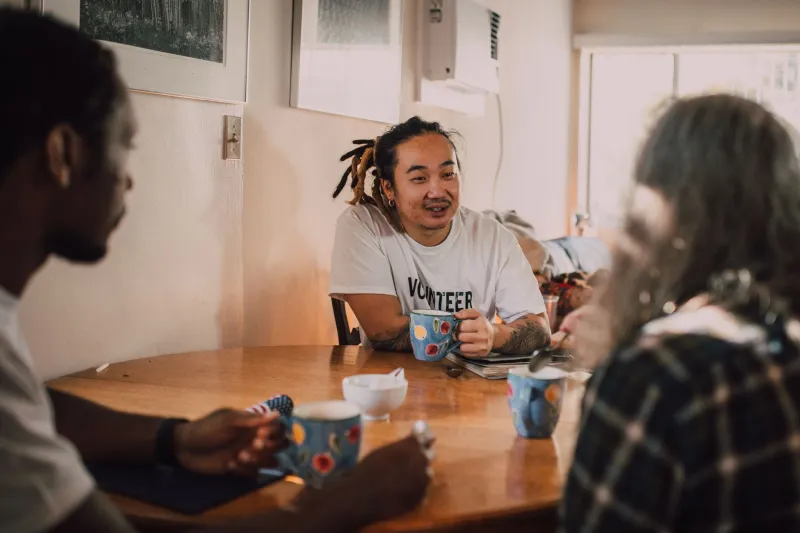
Greg Chen is an introvert. He will tell you that himself. He does not stand at the door shaking hands. Instead, he arrives early to arrange the folding tables—not in long cafeteria rows, but in clusters of four and six, with a little breathing room between them.
‘A long table feels like a meeting,’ he says. ‘A small table feels like a conversation.’
Greg also sets up a quiet corner near the window: two chairs, a small side table, no expectation of group chatter. It is the spot where first-time visitors often land, and where people who need a minute after worship can sit without being swarmed. The ministry of the second cup, he says, is mostly about geometry and patience. Make it easy to stay. Make it easy to leave. Make it clear that neither choice is rude.
The Introvert’s Cup
Not everyone who lingers is outgoing. Some of the most faithful second cup people are the ones who barely talk. They come for the warmth of the room, the clink of mugs, the low hum of voices. They may sit with one person for twenty minutes and say little. They may help wipe down a table and slip out the side door.
That is allowed here. The team has learned not to confuse hospitality with high energy. No one is asked to share a highlight reel of their week. No one is forced into a circle. The only rule is simple: if you are here, you belong to the hour.
A First-Timer’s Second Cup
Dana Whitfield visited Faith Alive for the first time in October 2026. She came alone, sat in the back, and planned to leave right after the service. But a woman named Ruth handed her a mug and said, ‘The coffee is not great, but the company is.’ Dana laughed. She stayed for one cup. Then another.
‘The second cup was when I stopped feeling like a visitor,’ Dana says. ‘Nobody asked me to join anything. They just asked if I wanted more coffee and told me about the Tuesday night mending group. It felt like being let in on a secret.’
That is the quiet math of the second cup. It does not require a program. It requires presence.
What the Second Cup Asks of Us
For congregations that want to extend belonging without overprogramming, the second cup team has a few hard-won suggestions. Keep the coffee warm longer than feels necessary. Do not stack chairs while people are still talking. Set up small tables, not just long ones. Train a few volunteers to notice who is standing alone—not to swoop in, but to make a gentle opening. And resist the urge to turn coffee hour into an announcement session.
Most of all, give people permission to linger. In a culture that rushes from one thing to the next, staying put is a countercultural act. It says: you are not a project to be managed. You are a person to be known.
Lingering as a Practice
The second cup is not really about coffee. It is about the space after the amen—the space where grief can surface, where a new parent can admit they are exhausted, where a teenager can hover near the snack table until they feel brave enough to speak. It is where the church becomes a body, not just a gathering.
Maria calls it ‘the ministry of the extra ten minutes.’ Greg calls it ‘table geometry.’ Dana calls it the reason she came back the next Sunday.
At Faith Alive UMC, the benediction is not the end. The urn is still on. The tables are still out. And there is a cup waiting for you—the second one, the one that means you stayed.