When the Yard Signs Come Down, the Welcome Mat Stays Out
The yard signs are down. The group chats are still up. Somebody's uncle is still posting. Somebody's cousin is still typing in all caps. And somewhere in the middle of the aftermath of the 2026 midterms, a lot of us are wondering how to be church together without turning the potluck into a debate stage.
This is not a call to pretend politics is nobody's business. It is a call to remember whose we are.
First, stop pretending politics is nobody's business
Faith has public implications. We cannot follow Jesus and be indifferent to hunger, housing, immigration, education, or how we treat the stranger. Our convictions matter. What we vote for matters. But the Communion table is not a political rally, and the church is not a precinct. We can hold conviction without making every conversation a courtroom.
After a divisive election, the temptation is to do one of two things: pretend nothing happened, or make every gathering a referendum. Both are exhausting. The better path is honest, bounded, grace-filled conversation that leaves room for the Holy Spirit to do what cable news cannot.
Three practices for the week after the midterms
1. Put a timer on hard conversations
Not every conversation needs to be a marathon. Try ten minutes. Ask, 'What do you want me to understand about your experience of this election?' Then listen. Do not fact-check every sentence. Do not look for a gotcha. When the timer goes off, say thank you and move on. If the conversation is still life-giving, you can always set another ten minutes. If it is not, you can stop without slamming a door.
2. Set social media boundaries like you mean them
You do not have to argue with a cousin at 11 p.m. You do not have to keep following an account that makes your jaw tight every morning. Mute is a spiritual discipline. Unfollow is allowed. Logging off is not surrender. If you run a church social media account, keep it focused on worship, service, and community life. Do not screenshot a sermon to win an argument. Do not use the church's page as a partisan megaphone. And if you are in a church group chat, agree on a simple rule: no forwarded political attack ads. If that rule feels too strict, try no forwarded political attack ads after 9 p.m.
3. Make worship do what worship does
Worship is not a break from the real world. It is where we learn to see the real world differently. Pray for leaders by name, including the ones you did not vote for. Keep Communion central. Do not turn the table into a prop for a point. Include silence and lament. Sing something that reminds you the kingdom is bigger than a midterm cycle. And please, do not make the sermon a recap of your favorite podcast's election analysis. The pulpit is not a cable news desk.
Boundaries are not a lack of conviction
A healthy boundary is not the same thing as avoiding conflict. It is a way of saying, 'I want to be in relationship with you, and I cannot do that if every conversation becomes a fight.' You can say, 'That joke is not okay here,' and still pass the potatoes. You can disagree about policy and still show up with a casserole when someone has surgery. Grace and truth are not enemies. They are neighbors.
The table is not a truce; it is a training ground
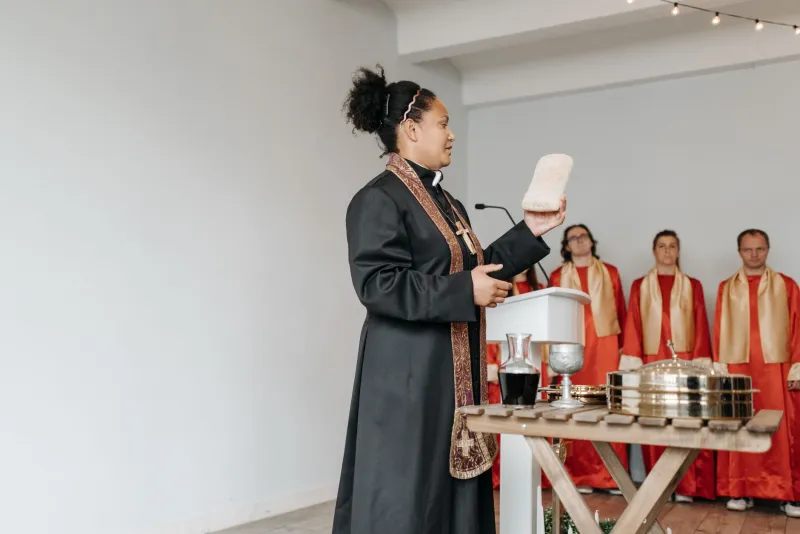
The Communion table does not erase our disagreements. It reorders them. At the table, we are not primarily voters or partisans or pundits. We are beloved children of God. That does not mean all opinions are equally wise or equally kind. It means the door is open, the welcome is real, and the grace is not earned by getting your politics right.
This Sunday, sit by someone whose yard sign you did not like. Pass the peas. Learn a name. Ask about their grandkid. You do not have to solve the election in the fellowship hall. You just have to be church together—one honest, bounded, grace-filled conversation at a time.